
Why low-watt GaN chargers shouldn’t exist, yet brands keep selling them
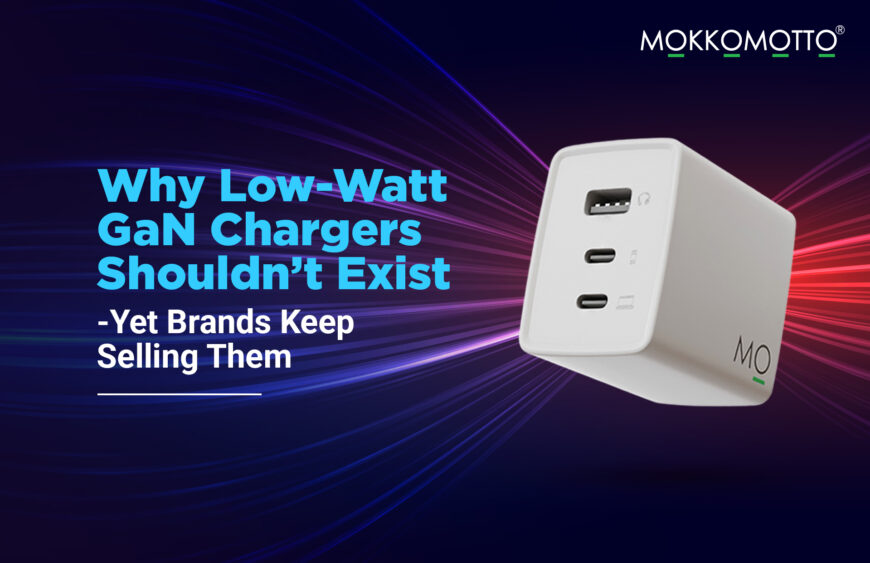
Search for “20 W GaN charger” on Amazon, and you will see small pastel cubes with bold claims: “pocket rockets” and “space-age tech”. Many listings talk about power, speed, and next-gen technology. What you will not see is the basic truth. At this watt level, silicon is already close to its physical limits. The size, heat, and efficiency are almost the same. Switching to GaN at 20 W does not change the user experience. The material is present, but the benefit is not.
Most shoppers do not have the time to read power tables or understand switching frequencies. Brands know this. That is why low-watt GaN chargers continue to sell in large volumes.
What are the limits below 30W?
GaN HEMT chips can carry more power than silicon. They can switch faster, which helps reduce the size of magnetics and makes the charger smaller. Also, they can reach higher efficiency when the full system is designed with great precision.
These strengths do not show clear gains below 30W, because the power level is too low for GaN to make a visible difference.
Here is a simple comparison that shows the difference.
| Parameter | 20 W Silicon | 20 W “GaN” | Delta | Consumer Feels? |
| Power loss | 1.1 W | 0.8 W | –0.3 W | ❌ |
| Total efficiency | 87 % | 88 % | +1 % | ❌ |
| Heat-sink requirement | none | none | 0 | ❌ |
| Volume | 28 cm³ | 26 cm³ | –7 % | ❌ |
| BOM cost | ₹190 | ₹410 | +₹220 | ✔️ (wallet lighter) |
So why do low-watt GaN chargers continue to dominate search results?
Several reasons explain this pattern.
- Product listings with the GaN tag get more clicks. “GaN” CPC is rising; slapping it on the label boosts click-through by 2.3× (Amazon ABA data Q3-24).
- Chargers in this range serve as easy refresh items for old SKUs. Shelf space is king. A new colour + “GaN” bullet creates a “new” product without fresh tooling.
- Customers assume GaN is always better and eco-friendly, and rarely question it (nobody audits the 4 g plastic saved).
- Most brands do not publish full power tables, which hides the real capability. Star ratings rarely drop below 4.0 because the charger still “works”; the buyer usually blames the cable if the speed is average.
What’s under the hood?
A teardown by our team on a popular “20 W Mini GaN” showed the following.
- Controller: silicon-based PI INN3265. The label says “GaN compatible”, but it drives an internal silicon MOSFET.
- FET: 600 V silicon, 90 mΩ. This is the same part found in basic ₹299 white-label chargers.
- Marketing spend: ₹34/unit (influencer kits, Amazon headline ads) vs ₹18 for true-Si counterpart.
The clear meaning is this: You paid for the label, not the semiconductor.
Where does GaN Tech actually help?
The real value of GaN HEMT appears when the use case demands more. For example, a single charger for a laptop, phone, and wearable. Or a compact charger for long work sessions where heat control becomes important. Or a multi-port setup where power needs to be shared without drops or slowdowns.
These situations create enough stress inside the charger for GaN to show clear improvement. Lower heat, stable output, smaller footprint, and longer product life.
Use this quick filter to identify your charging needs:
- For phone-only use, a low-watt silicon charger is enough
- For laptop and multi-device use, choose a charger in the 60 W to 100 W range
- For heavy workloads or frequent travel, pick a compact GaN charger that supports stable power sharing
- Always check the power table before you buy, not just the headline watt number
Below those thresholds, GaN is just a more expensive way to do exactly what silicon already does, like hiring a Formula-1 driver to deliver groceries in a school zone.
Smart Buying Pointers for GaN Chargers
- Avoid purchasing GaN chargers below 30W as they offer no meaningful functional advantage over traditional silicon chargers. You’re essentially paying for marketing hype rather than tangible performance gains.
- At the 230V input level, low-watt GaN units often deliver only 87% efficiency, barely outperforming quality silicon chargers at 95%+. The real-world difference is imperceptible.
- Cost vs. benefit mismatch — You’re paying a premium for a technology that only justifies itself at higher wattages (60W+) where heat dissipation and thermal management actually become critical factors.
- When GaN actually matters — The technology shows genuine advantages starting at 60W and above, where noticeable improvements in size, heat output, and efficiency become practical benefits.
Bottom line:
If you’re charging only a phone, save money with a ₹299 silicon 20W charger. If you need to power multiple devices (phone + earbuds + laptop), then step up to a 60W GaN charger where the investment genuinely pays off. Anything in between is pure marketing.


