When you’re in a rush and your device is hanging on to its last few percent of battery, waiting around for it to charge isn’t exactly ideal. That’s where newer charging tech steps in to make life easier. One of the most exciting developments in this space is the rise of GaN (Gallium Nitride) chargers paired with USB Power Delivery (PD). This powerful combo is changing the way we power up everything—from phones and tablets to high-performance laptops—offering faster speeds and broader compatibility than ever before.
But what exactly makes this combo a must-have for tech-savvy users? Let’s break it down.
What is GaN Technology?
GaN (Gallium Nitride) is a cutting-edge semiconductor material that’s revolutionising power electronics. Traditionally, chargers used silicon-based transistors, but transistors made from GaN are called High Electron Mobility Transistors (HEMT), which allows for faster and more efficient energy transfer with less heat generation. This means:
- Higher power output with faster switching speed, leading to higher operating frequencies, resulting in smaller form factors.
- GaN HEMTs have less loss, leading to higher energy efficiency.
- A wide range of applications, like power supply for space stations, EV chargers, and powering AI data centers.
Because GaN chargers generate less heat, they can pack more power into compact designs, making them ideal for today’s mobile lifestyles.
For more information, please visit our website
What is USB Power Delivery (PD)?
USB Power Delivery is a fast-charging standard developed by the USB Implementers Forum (USB-IF), designed to deliver significantly higher power over a USB connection. As per USB.org, the most recent specification (USB PD 3.1) supports up to 240W of power, enabling charging not only for phones and tablets but also for demanding devices like portable displays and printers.
Unlike traditional charging standards that follow fixed power “rules,” USB PD introduces intelligent power negotiation. The charger and device communicate to deliver the optimal voltage and current, ensuring faster, safer, and more efficient charging.
Key benefits of USB PD include:
- Universal compatibility
- Standardised Fast-charging across devices
- Smart power delivery scaling
- Standardization around USB-C connectors
USB PD is leading the way toward a truly universal fast-charging standard.
Why Combine GaN with PD?
By combining GaN technology with USB PD, users get the best of both worlds:
- Compact chargers with powerful output
- Faster charging with less heat generation
- Support for a wide range of devices
- Energy efficiency and reduced power loss
A single GaN PD charger can power up everything from your smartphone and tablet to a printer, portable monitor, or even a gaming laptop, eliminating the need for multiple bulky chargers.
What to Look for When Buying a GaN PD Charger
With so many GaN PD chargers on the market, it’s essential to know what sets the best apart. Here are key buying considerations:
1. Power Output Range
Check the wattage your devices need and match it with the charger’s max output:
- Smartphones/Tablets: 18W to 30W
- Portable Gaming Consoles: Around 45W
- Printers/Monitors/Photocopiers: 65W to 140W
- High-Performance Laptops: Up to 240W with PD 3.1
A charger that supports multiple power profiles ensures it will meet the needs of a variety of devices between 10W and 140W.
2. Support for USB PD 3.1, PPS, and Qualcomm QC4
Look for compatibility with USB PD 3.1, PPS, and QC4 to future-proof your purchase. This latest revision of PD3.1 expands power capabilities to up to 240W, making it versatile enough for even more demanding devices.
- Port Configuration
Multi-device households should opt for dual or triple USB-C port chargers. Some GaN PD chargers offer smart distribution, adjusting power based on which ports are in use.
4. Safety & Certifications
Look for compliance with recognized national and international certifications such as:
- BIS Certification (Bureau of Indian Standards) – Mandatory for electronic products sold in India under the Compulsory Registration Scheme (CRS). Check for the R-xxxxx number mentioned below the BIS logo.
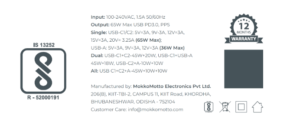
- IS 13252 (Part 1):2010 –International Electrotechnical Commission standard for the safety of information technology equipment (ITE).
- RoHS Compliance – Though not a mandate, this indicates restriction of hazardous substances.
- USB-IF Certification – Ensures USB Power Delivery standards compliance for cross-device compatibility.
- CE and UL (optional) – These international certifications indicate additional quality and safety benchmarks.
Note: Always verify the BIS registration number on the packaging or product label before purchase.
5. Portability
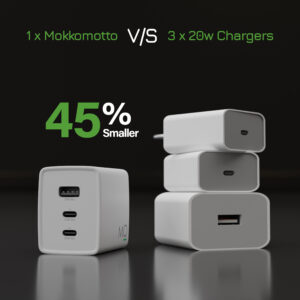
One of GaN’s most significant advantages is its compact design. If you’re always on the go, look for foldable prongs, travel-ready size, and high wattage in a small form factor.
Real-World Use Cases
GaN PD chargers cater to a wide range of users:
- Mobile Professionals: Charge phones and tablets simultaneously, anywhere.
- Gamers: Power portable consoles or high-performance laptops without bulky bricks.
- Creative Professionals: Keep portable monitors, photo printers, and label printers running seamlessly.
- Remote Work Setups: Power webcams, docks, and accessories from a single charger.
The interoperability of USB PD ensures seamless usage across all major brands and device types, from Apple and Samsung to Dell, Lenovo, and beyond.
The Future of Charging: Efficiency and Interoperability
As devices grow more powerful, chargers must become more intelligent and versatile. That’s why the GaN + PD combination is the future of mobile power. With USB PD emerging as the universal fast-charging standard and GaN allowing high wattage in compact forms, this duo is set to dominate the next generation of chargers.
The shift away from fixed power rules, as outlined by USB.org, allows manufacturers to innovate while maintaining full cross-device compatibility—a win for both brands and consumers.
Final Thoughts
If you’re a tech-savvy buyer seeking the ultimate charging solution, look no further than a USB Type-C Multi-port GaN charger with USB PD, PPS, and QC functionality. It delivers speed, efficiency, portability, and most importantly, universality. One compact charger for all your devices, from a smartphone to a high-performance printer.
When shopping, prioritise:
- PD 3.1 support
- Multi-device output (10–140W)
- Reliable certifications
- Portable GaN design
In a world of growing device ecosystems, a GaN PD charger is more than an accessory—it’s a central part of your mobile power strategy.
The Mokkomotto MoCharge65 is now available on Amazon—take a look and see if it’s the right fit for your devices.
FAQ
Q: What is a GaN charger?
A: A GaN (Gallium Nitride) charger is a next-gen fast charger that’s smaller and more efficient than traditional silicon chargers. It supports high power in a compact design.
Q: What makes USB PD chargers different?
A: USB Power Delivery (PD) is a universal fast-charging standard that supports smart power negotiation and delivers up to 240W to compatible devices.
Q: Which device brands are compatible with a GaN PD charger?
A: GaN PD chargers are widely compatible with major tech brands like Apple, Samsung, Google, Dell, HP, Lenovo, ASUS, and more. Thanks to USB Power Delivery (especially PD 3.1), these chargers can power a wide range of devices—smartphones, tablets, laptops, and even monitors—regardless of brand, as long as the device supports USB-C charging.